
All content described here is currently a work in progress but is protected by the terms of use statement.
This is one of the most innovative features of the site. The public doesn’t have to rely solely on elected representatives to come up with all the ideas that go into lawmaking. That’s not what “representative democracy” means, particularly in an age when it is easy to develop powerful tools for public involvement.
Being a committed legislator means facing the challenge of decision making for important issues many of us lack the will to even consider. Lawmakers typically are not experts in any particular field, they are mired in fundraising efforts, and have to deal with many constituent requests, but they are still tasked with making the most critical decisions affecting our nation. This job is difficult; especially when many constituents are not actively expressing their views, or giving guidance as to what they truly want. Our lawmakers need expert advice. Why not tap into the expertise in our citizenry that often lies dormant or ignored?
Eric Cantor, former Republican House Majority Leader, set a great example for how Congress could better use technology in the process of drafting legislation when he created a site called “YouCut”, where the public could vote on ways to cut federal spending and the House would conduct actual legislative votes on the floor in response to public demand on the site (Newsom, 2013). In the first week 700,000 people voted for their desired cuts and that trend of activity continued through the life of the project. Many dismissed this project as a mere PR stunt rather than a genuine attempt to solve the problems of federal spending, but Cantor defended it, arguing that YouCut was designed less for solving the problem of spending cuts and more to “change the culture in Washington” (Susteren, 2010). Matt Lira, one of Cantor’s advisors, said that the important effect of YouCut was to “bring people through the system in ways that can have genuine impact on the process” (Newsom, 2013). He posed the question “How can we incorporate social media into the act of governing itself – not just as a communication device. The key to that is participation” (Newsom, 2013).
One answer to Lira’s question can be found in the Open-Source Legislation feature offered by Digital Citizen. This tool will take several steps beyond the YouCut model. Open-Source Legislation can increase transparency and participation in the legislative process by offering the public an active role in drafting laws.
Much like open-source software development, which has produced some of our greatest tech advancements, Open-Source Legislation enables us to “cherry pick” all of the best contributions made by the public and bring them together to create the ultimate final product in a well-drafted law. All of the open-source legislation bills will be mock bills, but they can provide a great frame of reference for lawmakers and give the public a great opportunity to participate in detailed, transparent discussions of laws that interest them. Who knows, maybe someday they can be used as actual bill texts.
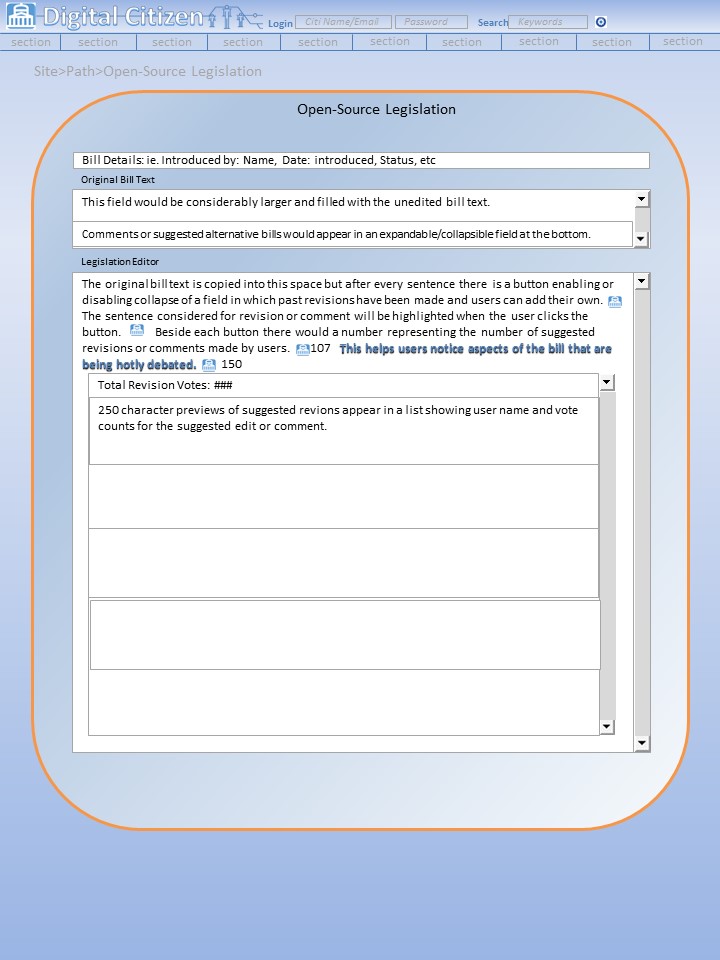
Legislation under debate in congress will be displayed in full and the text broken down into paragraphs and sentences which can be commented on individually and “voted up” or down as part of the bill. When revisions are voted up they are moved to the top of the suggested revisions list. The original text remains intact unless the author of the bill changes the actual bill in Congress. Politicians themselves will be strongly encouraged to use this tool by commenting and recommending revisions to show the public why they support or oppose bills based on their inner workings. This tool can also help shape legislative outcomes by giving representatives impressions of the popularity for certain aspects of a bill, in addition, empowering people to show support or opposition to the bill as a whole.
In this section, users would also be able to draft their own legislation from scratch and see their peers, or the general public, vote on it. Users can make their legislation open-source, meaning that others can input recommended revisions which can also be voted on. Many bills in Congress come with conditions unrelated (not germane) to the main issue addressed by the bill, and the Open-Source Legislation feature may help prevent special interests from attempting to covertly pass their legislative agendas with sneaky tactics of tucking measures into bills where no one expects them. This feature uses the power of the internet to democratize the creation of drafting legislation and is akin to the open-source projects of software developers who innovate for a better technological future. In this way, we can innovate as a society seeking a better political future.
In keeping with the theme of interconnectivity across the features of the site, these line items, paragraphs, revisions, comments, and entire bills can be turned into debates, shared events, and posts on one’s profile page etc. Furthermore, honor badges can be earned in this section for those who create their own bills, suggest revisions, comment or vote on bills, vote on revisions, or meet thresholds in having their revisions/comments/bills voted up by other users. Achievements may also earn unlockable tag lines appearing with one’s profile. A possible tagline earned for participation in the open-source legislation section could be “laying down the law!”.
A brainstorm image:
 Digital Citizen